Posts

Showing posts with the label hazard

Earthquake Hazards: Tsunami

Image
 A tsunami is a high sea wave. It can travel hundreds, even thousands, of miles across the ocean. While over deep water, they can be difficult to detect due to their large wavelengths, which can take 20 to 30 minutes for it to cycle and may only have a few feet of height. As the tsunami passes through shallower water, wave shoaling compresses the wave, making it slower and taller. Tsunami wave rises high and quick over steep coastline Tsunamis can be caused by vertical displacement of the seabed due to an earthquake. They can also be caused by a landslide crashing into the water, and that landslide could have been caused by an earthquake. A December 2004 Indian Ocean earthquake of magnitude 9.1–9.3 caused tsunamis along the coasts of the Indian Ocean. The tsunami waves killed 230,000 to 280,000 people, with heights up to 100 feet. The earthquake was the third largest since recording started in 1900, and it caused one of the deadliest disasters in modern history. It was also the lo...

Earthquake Hazards: Surface Fault Rupture

Image
 A fault rupture is a slip and resulting displacement along a fault. When that rupture extends to the earth’s surface, where we can see it, it’s called a surface rupture. These surface fault ruptures can be vertical or horizontal, and can happen in a small location or extend over a larger area. In many earthquake hazards, surface fault ruptures are identified as ground displacement. Not all earthquakes will produce surface ruptures. The biggest problem with surface ruptures is when a building or other structure is over the rupture. California passed the Alquist-Priolo Earthquake Fault Zoning Act in 1972 to mitigate surface ruptures. The Act prevents the construction of human-occupied buildings on the surface of active faults.  Outside of California, many other earthquake hazard locations don’t have statutes regulating development on faults with surface rupture potential. The main reason for the lack of regulations is usually a lack of historical evidence of earthquakes rupturi...

Earthquake Hazards: Tectonic Subsidence

Image
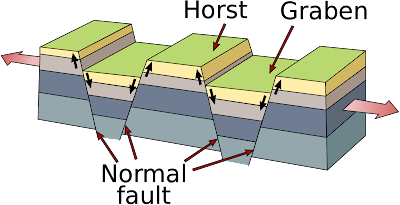
 Subsidence is the lowering of the ground surface. Tectonic subsidence is the lowering of the ground as a result of an earthquake.  While there are subsidence can occur as the result of different types of tectonic actions, generally tectonic subsidence happens when the vertical movement of ground causes nearby ground to lower in relation to it's previous location. This is what can happen with normal faults. In a normal faulting zone, subsidence is evident from the creation of horsts and grabens, raised or lowered blocks of crust. Horst and graben along normal fault zone. USGS image, public domain. A pull-apart basin can be created in a strike-slip fault zone. Strike-slip faults are where the blocks of crust have faults that are vertical, or near vertical, and movement on the fault is usually sideways (horizontally). A pull-apart basin forms when opposing walls of the fault pull apart from each other, resulting in dropped ground. Tectonic subsidence may also occur when loose...

Earthquake Hazards: Release of Hazardous Materials

Image
 Just as an earthquake can damage or destroy buildings, cause liquefaction , landslides , seiches , fires , flooding , dam failures , and tsunami, the shaking can cause the release of hazardous materials. This release can happen as hazardous material storage tanks or containers are damaged. And don't be complacent and think only facilities that manufacture hazardous materials are at risk.   Many manufacturing and other facilities use various hazardous materials throughout their processes, and a tremor could cause the release of these materials through damaged or destroyed distribution or storage systems.  One consideration, which you have no real control over, is the transportation of hazardous materials. While uncommon, accidents involving vehicles with hazardous materials--which include trucks and railcars--do happen. In these accidents, depending on the hazardous material(s), whole blocks, neighborhoods, or even sections of a city may be put on lockdown or evacuat...

Earthquake Hazards: Landslides and rockfalls

Image
The obvious hazard of an earthquake is the shaking of the ground. I'm not aware of anyone being killed directly by the ground shaking. The exception might be when the ground opens up. There have probably been some indirect deaths of the earth shaking if someone died from a heart attack. Most of the injuries and deaths are the result how the ground shaking affects other things. These are the earthquake-related hazards. Shaking of the earth shakes buildings. This is the obvious earthquake hazard. Related to the collapse of man-made structures is the threat of the destabilization of the ground. One of these hazards is liquefaction . Other earthquake-related hazard caused by ground destabilization, which many people don't consider but which becomes obvious when mentioned, are landslides and rockfalls. While landslides and rockfalls are similar, rockfalls are primarily when only rocks (which can small or large) are what come down. Landslides are the downward sliding of a mass of ear...

Earthquake Hazards: Liquefaction

Image
With the focus on earthquakes so often on the shaking and potential infrastructure and building damage, there are other hazards the shaking causes that are sometimes overlooked or minimized. One of those hazards is liquefaction. Liquefaction is one of the earthquake hazards I'm more concerned about where I live because according to the liquefaction-potential maps, my home is in an area with high liquefaction probability.  So, what is liquefaction?   When soil is saturated, or partially saturated, it can act like a liquid when it is sufficiently agitated or shaken (like, by an earthquake). Loose sand and silt-based soils are most susceptible. As the earth shakes, the soil loses its strength and stiffness and begins to behave more like a liquid, where anything on the surface could sink or move. Even the liquefaction of buried layers of soil can cause these problems. As a side note, one of the parables taught by Jesus in the New Testament (Matthew 7:24-27) was about a wise m...

Earthquake Hazards: Flooding

Image
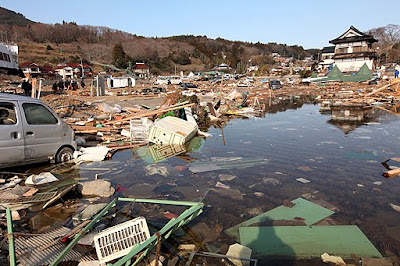
Like many of the other earthquake hazards, a lot of people don't associate flooding to an earthquake...until they really think about it. When earthquake hazards are discussed, it's not just the obvious shaking of the ground, it's what the shaking of the ground can potentially cause. I'm not sure if the actual shaking of the earth even kills anyone. It's the effects caused by the earthquake that are the hazards.  For example, buildings collapsing are caused by the earth shaking. Similarly, if you have water near your home, you could experience earthquake-induced flooding.  Earthquake-induced tsunamis, seiches , and dam failures can all lead to flooding. Debris in flooded street at Uranohama Port, Japan, on 1 April 2011, in aftermath of earthquake and subsequent tsunami.  Thankfully I live far enough from any large body of water that I'm not concerned with a earthquake-caused Tsunami, like the 2011 Tohoku, Japan earthquake that shook at magnitude 9.1 and caused a...

Earthquake Hazards: Fire

Image
Most people don't think about this; fires can break out in the aftermath of an earthquake.  Damaged fuel tanks or leaking gas pipes can contribute to the fire danger. Fallen electrical lines and damaged transformers are only a couple of potential spark producers that can ignite fires. Some fires could be ignited by stoves tipping over or a flammable object igniting on a stove left on during an earthquake. Gas stoves, water heaters, furnaces, and other appliances can also pose an increased fire risk if the gas isn’t shut off completely. It's not just gas appliances. If something flammable lands on an electric stove that's on, it's likely to catch fire. Similarly an electric space heater that falls over, shakes over against a bed, couch, curtain or other flammable item could also ignite into flames. To make matters worse, water availability, specifically through the municipality’s water supply, may be limited or non-existent due to water main damage caused by the earthqua...

Earthquake Hazards: Damaged Infrastructure

Image
 Damaged buildings are what most people expect in the aftermath of a strong earthquake. However, roads, bridges, water supply, electrical grid, railways, airports, and other structures and facilities that support our modern life--the infrastructure and backbone of our society--are all at risk.  What happens when damaged infrastructure makes life anything but normal? The first effect is when damaged infrastructure--including various modes and systems of transportation--delays response time by first responders, medical assistance, fire fighting, and other assistance. This delay not only affects local help but also hinders aid from outside sources. Transportation of food and supplies will be slowed or even stopped. Damaged roads, airports, train stations, and ports will all affect the flow of aid, materials, food, and outside assistance to the area of impact. To make matters worse, the harder hit areas will have their infrastructure hit harder, further complicating rescue, assist...

Earthquake Hazards: Aftershocks

Image
Every earthquake has aftershocks, which are essentially earthquakes of lesser intensity than the original mainshock. Although they could technically be argued as separate earthquakes with their own related hazards, aftershocks are a hazard. The main earthquake may not have been expected, but you can expect these additional quakes and you should be wary around any damaged structure or building that has not be identified as safe. The biggest aftershocks generally occur within the following 30 days, with the intensity of the aftershocks decreasing over time. Think of it this way, these are earthquakes you can actually expect, and, to some extent, plan for, even if you don't know the exact day or time when they will strike. More about Aftershocks and Foreshocks and Aftershocks on this page Aftershocks - mathematical formula I won't pretend to understand the mathematics behind aftershock prediction and modeling, but here's a oversimplification of the idea. When you through a pe...

Earthquake Hazards

Image
What are earthquake hazards? There are more than the obvious. The most obvious hazards of earthquakes are the earth shaking and damage to buildings. Included with the ground shaking are the hazards of objects falling down and injuring (or killing) you. Most people expect damaged and collapsed buildings after an earthquake, although, unless you’ve actually seen the aftermath of a large earthquake it can be hard to visualize as videos don’t provide the same impression.  Besides the main earthquake, the single biggest earthquake hazard most people face is entering into an unsafe building. Buildings damaged by earthquakes can increase your risk of injury or death, particularly if an aftershock strikes and causes the already weakened structure to partially or fully collapse. Incidentally, the risk of falling debris is the biggest reason you shouldn't go running (or walking) out of a building during an earthquake. And, if you're near a structure during a quake, particularly if it...

Earthquake Hazards: Dam Failure

Image
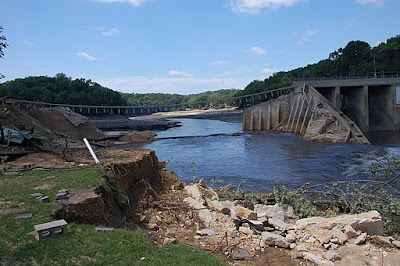
 If you live downstream, a dam failure should be a concern for you. While many dams are built to a high seismic rating, there are many which are not. The only way to discover a dam’s seismic rating is to do some investigating as you probably won’t find it stamped anywhere on the dam structure itself. There may be some plans in place in case of a failure, but most of the time these contingencies are based more on minor failures and not a catastrophic, complete failure, which could cause widespread flooding devastation. The following image is of a dam failure (not earthquake caused) in Iowa.  Dam failure in Iowa. Photo by Josh deBerge, FEMA, public domain Dam Fails However, it seems that some dams may be overrated on the integrity of the dam’s superstructure, and don’t give much credence to the possibility of complete failure. It’s true that most of the time dams do not suffer a complete failure. But there are been unexpected failures. While not caused by a seismic event, the Te...

Earthquake Hazards: Seiche

Image
One of the many additional hazards an earthquake may cause is a seiche.  A seiche is a standing wave of water that moves back and forth across a semi- or fully-enclosed body of water. On a small scale, the sloshing movement of waves across a pool or bathtub is a seiche. These same wave movements can be found on a larger scale in bays and lakes. When I experienced a 7.9 earthquake (from 65 miles away), I witnessed these waves in our pool. The pool was below ground and there was a small ledge about 12-14  inches high around the pool. The water was always at or below ground level, so there was more than 12 inches from the top of the ledge to the water.  When we ran out the back door of your house and under the grape arbor (which was dropping grapes) I looked towards our pool. What I saw was about 3-foot waves cresting and sloshing around the pool. I'm not sure if anyone else in the family even saw it, but the memory is vivid. I even wondered if what I remembered was real, un...