Posts

Showing posts with the label foreshock

Foreshocks and Swarms

Image
 Other pages have discussed foreshocks as indicators of an impending earthquake.  Foreshocks are often stronger than expected (minor to moderate category), unusual or unexpected earthquakes that occur in or near a high earthquake risk area.  Unfortunately you don't know an earthquake is a foreshock until a bigger quake happens. Earthquake swarms are lots of smaller earthquakes within a geographically small area, usually on or near the same fault line. Like a foreshock, an earthquake swarm could also indicate an impending, larger earthquake. The problem is foreshocks and swarms don’t come with a “prepare for a bigger one” warning.  It's difficult to identify when in the future a bigger earthquake will rupture. Usually quakes identified as a foreshock happen within a few days preceding the main shock. The reality of foreshocks and swarms is it’s hard to definitively state either is an indicator of a larger earthquake until after a larger quake strikes. In other words, ...

The Longest Earthquake Observed

Image
 2004 Indian Ocean Earthquake For me, the 2004 Indian Ocean Earthquake was the first big earthquake of the 21st century. It occurred on December 25, 2004, about 100 miles (161 km) off the west coast of Sumatra, Indonesia. As an undersea megathrust earthquake, it had a magnitude 9.1-9.3 (depending on what source you refer to) and caused massive tsunamis that flooded coasts around the Indian Ocean. Longest  Earthquake Observed The quake has the distinction of being the third-largest ever recorded by a seismograph, and it was the longest ever observed, lasting from 8.3 to 10 minutes, depending on the station that was recording it. While the earthquake itself didn’t cause much damage, the tsunami waves up to 100 feet (30 m) high killed an estimated 227,898 people in 14 countries. The quake was also believed to have triggered a number of other earthquakes, including some in Alaska.  Here's something I find fascinating. Some seismologists believe the 2002 Sumatra earthquake, w...

Foreshocks and Aftershocks

Image
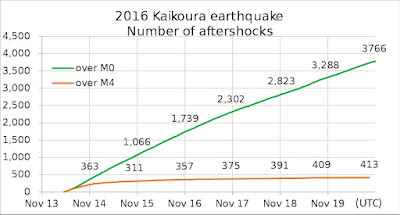
  Sometimes a large earthquake is preceded by smaller quakes. The smaller earthquakes are known as foreshocks. If a large number of the earthquakes occur is called an earthquake swarm.  On April 23, 2017, there was a report of a significant earthquake swarm off the coast of Chile near Valparaiso. The next day a magnitude 6.9 earthquake struck the same area. Aftershocks are the earthquakes and tremors that occur after a larger earthquake. The magnitude of aftershock earthquakes can be as high as the original earthquake. Aftershocks can occur immediately after main quake, and continue occurring days, weeks, or months afterwards. Hundreds and even thousands of aftershocks can follow a significant earthquake, although only a small percentage will be large enough to cause significant additional damage. It is not uncommon for aftershocks to end up causing more damage than the main earthquake as the main quake will significantly weaken structures, and the aftershocks may finish the j...