Posts

Showing posts with the label early warning

Update on QuakeAlert

Image
 In my post Earthquake Early Warning  one of the earthquake early warning systems mentioned was QuakeAlert. Developed by Early Warning Labs , who partnered with USGS, QuakeAlert's objective is to quickly detect the initial energy waves produced by an earthquake. These first energy waves, called P-waves, rapidly radiate from the epicenter.  Using P-waves the location, magnitude, and anticipated ground shaking (this correlates to possible damage is basically what the Mercalli Intensity Scale attempts to quantify) can be estimated. Based on these estimations warnings are distributed to state emergency response, critical infrastructure, businesses, and the public before the damaging S-waves hit. The S-waves are when the real shaking and damage occur. Depending on the earthquake's magnitude, depth, and other factors, such as ground composition and your distance from the epicenter, your warning may give you up to 60 seconds before the earthquake strikes. The expectation is to ...

Foreshocks and Swarms

Image
 Other pages have discussed foreshocks as indicators of an impending earthquake.  Foreshocks are often stronger than expected (minor to moderate category), unusual or unexpected earthquakes that occur in or near a high earthquake risk area.  Unfortunately you don't know an earthquake is a foreshock until a bigger quake happens. Earthquake swarms are lots of smaller earthquakes within a geographically small area, usually on or near the same fault line. Like a foreshock, an earthquake swarm could also indicate an impending, larger earthquake. The problem is foreshocks and swarms don’t come with a “prepare for a bigger one” warning.  It's difficult to identify when in the future a bigger earthquake will rupture. Usually quakes identified as a foreshock happen within a few days preceding the main shock. The reality of foreshocks and swarms is it’s hard to definitively state either is an indicator of a larger earthquake until after a larger quake strikes. In other words, ...

Earthquake Lights

Image
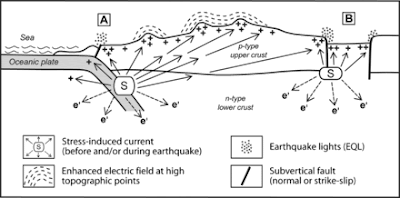
 Earthquake lights (EQL) are phenomena that are sometimes reported in conjunction with an earthquake. These EQL could take the form of balls of light, steady glowing lights, sheet lightning, bluish flames appearing to come out of the ground, or flashes of light similar to lightning except they come from the ground. Usually the EQL is seen before or at the time of the earthquake, near the epicenter area. Because of the rarity of the event, and insufficient evidence to formulate a conclusion, some geophysicists doubt whether there really could be EQL as some of the sightings have been attributed to such things as power lines shaking and arcing. This image is a simplified model of the subduction zone environment and where earthquake lights are likely to be seen. (Image retrieved from https://upload.wikimedia.org/wikipedia/commons/9/9f/How_EQL_form.gif and is attributed to ScienceResearch / CC BY-SA (https://creativecommons.org/licenses/by-sa/4.0) Creative Commons Attribution-Share Ali...

Earthquake Early Warning

Image
People have been trying to predict earthquakes as long as earthquakes have been happening.  Some claim to have dreams or visions that predict an earthquake, but this is a bit unreliable especially pertaining to when and where.  There have been some scientific studies regarding earthquake prediction but these have primarily related to analyzing data that was gathered prior to earthquakes. This is hit and miss because often the data desired was collected because nobody knew it would be needed. And that's the other issue, what data is needed, if it's actually possible to predict earthquakes. A few of the somewhat predictors are foreshocks, earthquake swarms, and possible earthquake lights. These, along with some other promising and interesting studies, warrant their own posts on another day. So, while predicting an earthquake hours or days in advance is still something we'd love to have, there are ways in some parts of the U.S. and other countries that you can get an "adv...