Posts

Look for coming posts on earthquake scenarios

 Thank you for taking some time to read my blog. As I'm sure it is with you, life is busy for me.  While it's been several weeks since my last post, I wanted to let you know that I have five posts in the works.  These forthcoming posts are earthquake scenarios for five of the potentially biggest "big ones" projected to strike the contiguous United States. No, these scenarios are not fictional case studies. Nor are they hyped up Hollywood-style disaster stories. These earthquake scenarios are based on projected risks and cost estimations made by state and federal experts. These experts use knowledge and experience from what is known about earthquake risks and hazards, often through historical and similar event references, in an effort to best calculate the potential and expected damage an earthquake or a projected magnitude will cause in an area. It's not if and earthquake strikes but when, how hard, and how might it affect the area.  Some of the scenarios are bas...

Earthquake Hazards: Tsunami

Image
 A tsunami is a high sea wave. It can travel hundreds, even thousands, of miles across the ocean. While over deep water, they can be difficult to detect due to their large wavelengths, which can take 20 to 30 minutes for it to cycle and may only have a few feet of height. As the tsunami passes through shallower water, wave shoaling compresses the wave, making it slower and taller. Tsunami wave rises high and quick over steep coastline Tsunamis can be caused by vertical displacement of the seabed due to an earthquake. They can also be caused by a landslide crashing into the water, and that landslide could have been caused by an earthquake. A December 2004 Indian Ocean earthquake of magnitude 9.1–9.3 caused tsunamis along the coasts of the Indian Ocean. The tsunami waves killed 230,000 to 280,000 people, with heights up to 100 feet. The earthquake was the third largest since recording started in 1900, and it caused one of the deadliest disasters in modern history. It was also the lo...

Earthquake Hazards: Surface Fault Rupture

Image
 A fault rupture is a slip and resulting displacement along a fault. When that rupture extends to the earth’s surface, where we can see it, it’s called a surface rupture. These surface fault ruptures can be vertical or horizontal, and can happen in a small location or extend over a larger area. In many earthquake hazards, surface fault ruptures are identified as ground displacement. Not all earthquakes will produce surface ruptures. The biggest problem with surface ruptures is when a building or other structure is over the rupture. California passed the Alquist-Priolo Earthquake Fault Zoning Act in 1972 to mitigate surface ruptures. The Act prevents the construction of human-occupied buildings on the surface of active faults.  Outside of California, many other earthquake hazard locations don’t have statutes regulating development on faults with surface rupture potential. The main reason for the lack of regulations is usually a lack of historical evidence of earthquakes rupturi...

Earthquake Hazards: Tectonic Subsidence

Image
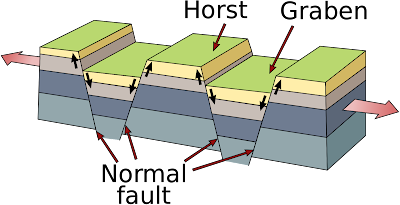
 Subsidence is the lowering of the ground surface. Tectonic subsidence is the lowering of the ground as a result of an earthquake.  While there are subsidence can occur as the result of different types of tectonic actions, generally tectonic subsidence happens when the vertical movement of ground causes nearby ground to lower in relation to it's previous location. This is what can happen with normal faults. In a normal faulting zone, subsidence is evident from the creation of horsts and grabens, raised or lowered blocks of crust. Horst and graben along normal fault zone. USGS image, public domain. A pull-apart basin can be created in a strike-slip fault zone. Strike-slip faults are where the blocks of crust have faults that are vertical, or near vertical, and movement on the fault is usually sideways (horizontally). A pull-apart basin forms when opposing walls of the fault pull apart from each other, resulting in dropped ground. Tectonic subsidence may also occur when loose...

Earthquake Hazards: Release of Hazardous Materials

Image
 Just as an earthquake can damage or destroy buildings, cause liquefaction , landslides , seiches , fires , flooding , dam failures , and tsunami, the shaking can cause the release of hazardous materials. This release can happen as hazardous material storage tanks or containers are damaged. And don't be complacent and think only facilities that manufacture hazardous materials are at risk.   Many manufacturing and other facilities use various hazardous materials throughout their processes, and a tremor could cause the release of these materials through damaged or destroyed distribution or storage systems.  One consideration, which you have no real control over, is the transportation of hazardous materials. While uncommon, accidents involving vehicles with hazardous materials--which include trucks and railcars--do happen. In these accidents, depending on the hazardous material(s), whole blocks, neighborhoods, or even sections of a city may be put on lockdown or evacuat...

Earthquake Hazards: Landslides and rockfalls

Image
The obvious hazard of an earthquake is the shaking of the ground. I'm not aware of anyone being killed directly by the ground shaking. The exception might be when the ground opens up. There have probably been some indirect deaths of the earth shaking if someone died from a heart attack. Most of the injuries and deaths are the result how the ground shaking affects other things. These are the earthquake-related hazards. Shaking of the earth shakes buildings. This is the obvious earthquake hazard. Related to the collapse of man-made structures is the threat of the destabilization of the ground. One of these hazards is liquefaction . Other earthquake-related hazard caused by ground destabilization, which many people don't consider but which becomes obvious when mentioned, are landslides and rockfalls. While landslides and rockfalls are similar, rockfalls are primarily when only rocks (which can small or large) are what come down. Landslides are the downward sliding of a mass of ear...

A super-eruption may not give warning

Image
 A large natural lake, called Lake Toba, in North Sumatra, Indonesia peacefully fills what is actually an ancient caldera of a supervolcano. Volcanic eruptions can affect a wide swath of the world, depending on the size of the eruption. Ash launched high into the atmosphere affects air travel with aircraft avoiding the ash clouds, or areas where ash could potentially be present. The ash particulates can not only affect visibility, they can also cause a lot of damage to an aircraft engine.  I was living in Federal Way, Washington in 1980 when Mt. Saint Helens erupted. We were too far away to see it. I remember about a week later there was a grayish dust over some of the things in our backyard. Turns out it was ash dust that had travelled around the world before it settled down. Supervolcanoes are one of the disasters that would seriously affect much of the world. Thankfully scientists estimate there are only 5-10 volcanoes in the world that are capable of super eruptions. The b...